Vehicles are no longer just a daily means of transportation, but have become an accurate indicator of the nature of societies, the level of income, the shape of cities, and the extent to which individuals depend on private transportation. In a world witnessing rapid urban expansion, data for the year 2025 reveal sharp differences between countries that are almost “suffocating” with the number of vehicles, and others where the car is still a limited luxury.
According to data compiled by World Population Review and S&P Global, the total number of registered vehicles globally is approx 1.77 One billion vehicles. However, the distribution of this number does not proceed at a similar pace, but is governed by multiple factors, including individual income, infrastructure, public transportation networks, social customs, and even the nature of geography and area.

Global Summit: When vehicles outnumber people
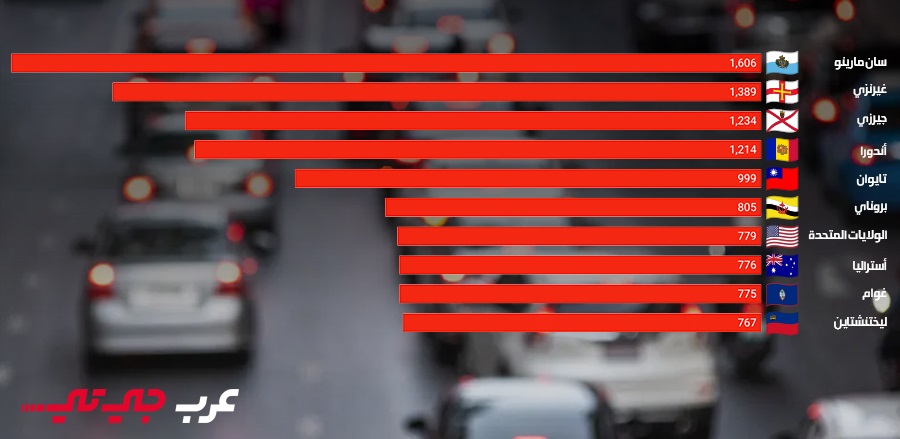
Topping San Marino The global scene has an unprecedented intensity of 1606 Vehicles per thousand peopleThis is equivalent to more than one and a half cars per person. Followed by small entities such as Guernsey, Jersey, and AndorraLimited space, high income, and ease of vehicle registration lead to an inflated number of cars compared to the population.
Advanced economies: high but understandable intensity
In countries like United States, Australia, Canada, Japan, and most of Western EuropeVehicle density is high, ranging between 600 and 800 vehicles per thousand people. These numbers reflect a lifestyle that relies heavily on cars, especially in sprawling cities and long distances, as well as the varying efficiency of public transport networks outside major urban centres.

Asia and the Middle East: mixed numbers
Approaching Taiwan From the full saturation barrier, recorded 999 vehicles per thousand peoplea number that reflects an almost absolute dependence on private vehicles on an island with a high population density and a transportation infrastructure with limited alternatives. On the other hand, the Arab countries show a clear difference in vehicle density despite the relative convergence in economic factors.
In the Bay Area, it registers Kuwait about 521 vehicles per thousand peopleWhile the density is Qatar about 512 vehicleswhile decreasing in United Arab Emirates to 376 vehicles per thousand people Only, a number that is lower than expected compared to the level of income, and this is due to the demographic composition that is dominated by residents, and the dependence of companies on fleets, in addition to the difference in vehicle registration policies.
Outside the Gulf, it registers Saudi Arabia about 224 vehicles per thousand peopleaffected by the breadth of the geographical area and the disparity in income levels between regions, while the density in Jordan Kinship 173 vehicles per thousand peopleThis is a direct reflection of the limited purchasing power and the high cost of ownership. As for EgyptSo you register Only 87 vehicles per thousand peopleWhich places it among the low-density countries, as a result of the high population density, the widespread reliance on mass transportation, and the high costs of car ownership compared to average income.
The flip side of the list: the countries with the least vehicles
On the other hand, the data reveals countries where the car’s penetration is still largely limited. Footer north korea The list globally at a rate of approx Only one car per thousand peoplefollowed by countries such as Somalia, Central African Republic, Togo, Madagascar, and EthiopiaIn most cases, the rate does not exceed 10 vehicles per thousand people.
These numbers do not only reflect weak demand, but are linked to deeper factors that include low per capita income, limited infrastructure, the absence of well-equipped road networks, and the dependence of a large segment of the population on alternative or informal means of transportation. There is also a clear global mobility gap between developed and developing countries, which is likely to continue in the foreseeable future.

In fact, vehicle density figures around the world reveal a story that goes beyond rigid statistics, as they reflect the daily lifestyle, the level of development, and the ease of access to transportation. Between countries that have reached the point of saturation with cars, and others that are still in their first steps, an unbalanced global map of people’s movement…and the movement of wheels is forming before us.